
Candle Dyes: How to Choose, Measure and Achieve Colour?
Soft pastels, rich moss green or warm autumn orange – colour helps set the mood of a candle and complement its fragrance. However, the final result depends on more than your chosen shade. The wax you use, the type of colourant you select and how you incorporate it all matter.
In this article, we explain the difference between candle dyes and pigments, how much to use and how to avoid common colouring mistakes.
Dyes or pigments: which should you choose?
First, decide whether you want to colour the entire wax mass or simply decorate the surface of the candle. These applications require different products.
Dyes for colouring wax throughout
BEKRO candle dyes are designed to be mixed into melted wax. Wax-soluble dyes colour the candle throughout. Our BEKRO dye–pigment blends are also intended for this purpose.
These products are unsuitable when you need sharply defined colour boundaries in an outer decorative layer: soluble dyes can migrate into the surrounding wax, causing the decoration to lose its crisp edges over time.
Pigments for surface decoration and overdipping
BEKRO pigments are used to create a coloured outer layer, for example by dipping a candle into pigment-coloured wax.
Unlike soluble dyes, pigments do not dissolve in wax – their particles need to be evenly dispersed. BEKRO describes its pigments as resistant to colour migration and suitable for colouring the outer surface of candles.
Do not use pigments to colour the entire wax mass of a candle intended for burning unless the specific product instructions explicitly permit this application. Pigment particles can interfere with the wick’s ability to draw up wax and impair burning. A light pigment shade alone does not mean it is suitable for colouring wax throughout.
Products for drawings and lettering
If you want to draw, write or create patterns on candles, choose KREUL candle pens.
How much candle dye do you need?
BEKRO dyes are concentrated, so start with a small amount and measure them using precision scales.
For the dyes and dye–pigment blends we offer, the suggested dosage is 0.1–0.2% of the wax weight, unless the individual product description states otherwise.
| Wax weight | Dye at 0.1% | Dye at 0.2% |
|---|---|---|
| 100 g | 0.1 g | 0.2 g |
| 500 g | 0.5 g | 1 g |
| 1 kg | 1 g | 2 g |
| 5 kg | 5 g | 10 g |
For pigments intended for surface decoration, the suggested dosage is 1–1.5% of the weight of the wax used for the decorative coating. For example, 1 kg of coating wax would require 10–15 g of pigment. Always follow the dosage recommendations for your chosen product.
More dye does not necessarily mean a better colour. Exceeding the recommended dosage may impair burning without achieving the intensity you want. Take particular care not to overdose blends containing pigments.
How do you incorporate dye into wax?
For an even colour, dyes must dissolve completely, while dye–pigment blends must be properly and evenly dispersed.
A convenient method is to prepare a colour concentrate first: mix the full amount of dye into a small portion of your total wax.
- Weigh the wax and dye. Calculate the dye dosage based on the total wax weight you intend to colour.
- Set aside some wax for the concentrate. This portion is included in the total wax quantity in your recipe.
- Incorporate the dye at the required temperature. Our BEKRO usage guidance recommends approximately 85–90°C for preparing the concentrate. Before heating, also check the temperature limits for your chosen wax.
- Add the concentrate to the remaining melted wax. Mix thoroughly. An indicative mixing temperature is around 65°C, provided this suits the wax and colourant you are using.
- Continue according to the wax instructions. Fragrance addition and pouring temperatures are selected separately – the temperature used to prepare the concentrate is not the pouring temperature.
For example, when colouring 10 kg of wax, you can prepare the concentrate using 1 kg of wax and the amount of dye calculated for the full 10 kg batch. Then mix it with the remaining 9 kg of melted wax.
This avoids heating the entire batch to the higher temperature needed to incorporate the dye.
Why does the colour look different from the photograph?
The same dye can look different in different waxes. The result depends on the wax’s original colour, transparency and composition, as well as the amount of dye used.
Our BEKRO colour samples are shown in a solidified blend of 90% paraffin and 10% stearic acid. The same shade may therefore appear softer and more pastel in soy, rapeseed or other vegetable waxes.
Treat the photograph as a colour guide. To check your own mixture, place a small drop of coloured wax on a cool, heat-resistant surface and allow it to solidify completely.
This provides an initial indication of the shade, but a small test candle is the best way to assess the final colour. Melted wax may look different from solidified wax.
Why does coloured wax develop frosting?
Soy wax candles sometimes develop whitish, crystalline patches known as frosting. This is associated with the natural crystallisation of the wax. It also occurs in uncoloured wax, but is more noticeable on coloured surfaces.
Frosting is not solely a sign of overheating. Wax composition, pouring and cooling conditions, and temperature changes can all influence it. Frosting itself is generally an aesthetic issue.
To help reduce its appearance:
- Follow the temperature recommendations for your specific wax. Avoid keeping wax at a high temperature unnecessarily.
- Try the colour concentrate method. This means only part of the wax is exposed to the higher temperature.
- Compare several pouring temperatures. A lower pouring temperature helps with some soy waxes, but testing is needed to find the best conditions.
- Allow candles to cool evenly. Avoid draughts, cold surfaces and sudden temperature changes.
- Record your test results. Change one variable at a time so you can identify what actually helps.
Frosting cannot always be eliminated completely, so when developing a collection, assess how your chosen colour looks in the wax over time.
Are candle dyes natural?
Candle dyes should not be confused with natural plant-based colourants. Furthermore, the term “organic colourant” in chemistry does not mean “natural” or “environmentally friendly”.
Candle colourants are formulated specifically for use in wax. Food colouring, plant powders and ordinary art paints are not equivalent substitutes.
If vegan composition or animal testing information matters to you, refer to the manufacturer’s declaration for the specific product. These characteristics cannot be determined from the dye’s name or colour alone.
Does the physical form of the dye affect its properties?
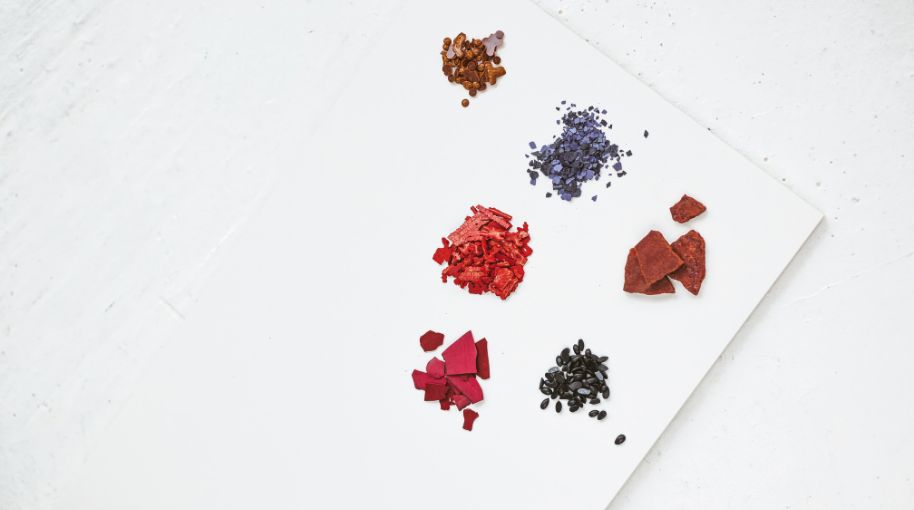
BEKRO dyes may come as flakes, broken pieces or granules. The appearance of the same product can vary depending on the production batch and manufacturing line.
A difference in shape alone does not mean that the composition has changed. Measure dyes by weight, rather than by the number of pieces or the volume of a teaspoon.
Test before making a larger batch
Once you have created a shade you like, make a test candle using your intended wax, fragrance, wick and dye dosage. Assess both its appearance and its burning behaviour throughout its useful life.
Record the exact proportions and processing temperatures so that you can reproduce your preferred colour more easily.
Explore our candle dyes and decorating products and start with small colour trials. Accurate dosing and the right product will help you create a consistent, carefully developed candle collection.