Small businesses in Lithuania still face financing challenges, especially when it comes to raising finance. This is why entrepreneurs themselves are looking for ways to not only create but also maintain a profitable business, using training and the experience of other successful entrepreneurs.
Laurynas Salys, Development Manager of Balsius, a company founded in 2016 that operates two online stores, says that it is important to critically assess one's income and expenses, manage finances purposefully and make decisions that benefit the company, not just please its founders. The e-commerce market is currently facing increasing challenges to maintain profitability. Increasing business revenues, increasing competition are putting increasing pressure on revenue growth. The speaker shared his experience on how to manage finances, how to set up a strategy and what to give up first if problems arise.
Building a profitable business is a challenging task, but then you also need to maintain profitability. How have you managed to create such a model and now to maintain it?
We try to maintain a wide range of products, constant replenishment, costing and margins. We replenish our stock wisely, i.e. we buy more in the pre-season, and at the end of the season we reduce our stock according to forecasts. We aim to build a loyal customer base that will keep coming back to find the right products for them. All our actions are oriented in two directions: to benefit the customer and to optimise our internal processes. Over the last few years, e-commerce has developed very quickly, the number of people shopping online has increased dramatically, which inevitably requires changes and investments in the e-shop. Continuous interest allows us to make the right decisions in time. Swedbank is helping to achieve this by continuously providing opportunities for small business owners to develop.
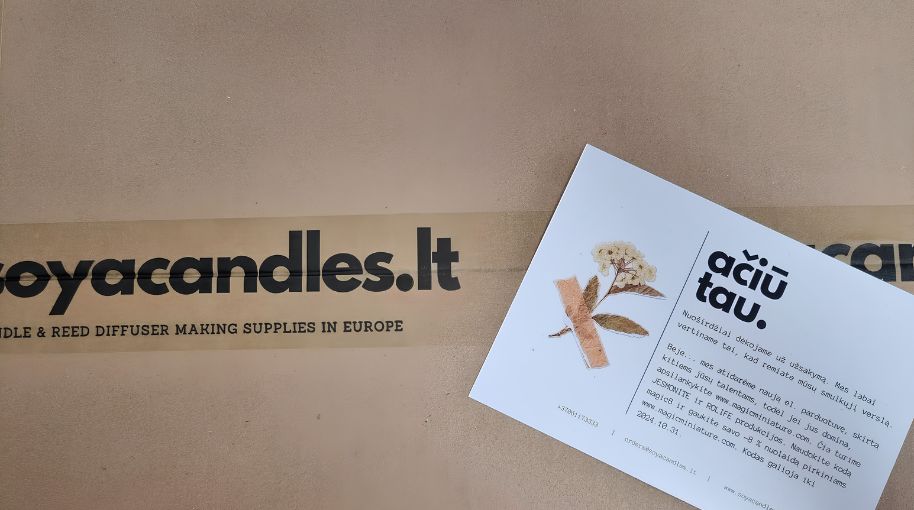
As competition inevitably grows, and in order to maintain profitability, it is necessary to look for ways to grow sales without increasing your fixed costs as much as possible. This is what we are currently doing by transferring our experience and know-how from one store - soyacandles.lt to the development of another - magicminiature.lt. We don't need additional staff for this and the cost of the e-commerce solutions is relatively low, as it is basically a copy of the existing solution. Experience and the right solutions allowed us not only to save money, but also to set up the new store in a very short time with a relatively small amount of work.
What are the means you use to increase revenue and how does this depend on the business areas of your stores?
First of all, we aim to have products that are useful to the customer, and we arrange the assortment in such a way that the customer can find the full basket of products he needs. For example, if a customer wants to make a candle, he will find wax, wick, jar, paints, scents. And not just one selection, but a wide range. This encourages the customer to buy everything from us, rather than having to "wander" through separate e-shops. We also use traditional marketing tools. We encourage you to buy more and save more with our automatic volume discount system, and we offer free delivery (in Lithuania and Latvia) from a certain basket amount. Off-season special discount vouchers for all products. For wholesale customers we offer personalised discounts.
However, it is important to note that the standard discount is only based on the quantity purchased (this is an unwritten standard in our market), but other discounts are only given after a targeted consideration of whether it will be beneficial in the longer term. We may be a bit unconventional in this respect, but we try not to abuse discounts, preferring to offer a better price immediately if we can.
How do you deal with competition?
We try to differentiate ourselves by offering more detailed advice, product descriptions, pricing, and we have official distribution rights for some products. Customers already know that we are quick to resolve problems when orders are lost, crashed, or for returns. We always try to be customer-oriented. Equally important is the aforementioned range of products. It is expensive to maintain, as you need to keep a lot of stock, but it also brings you a larger customer base.
We promote sustainability and have our own Facebook group where we invite customers to share their joys and challenges, but also to pass on discarded products. We reuse almost all recyclable packaging ourselves to reduce waste. Some of our customers notice this and even openly say that it makes them happy.
To be competitive, we also try to improve ourselves. We take part in training courses, have regular discussions with manufacturers about their product innovations, go to trade fairs ourselves and so on.
What are your cost management strategies?
Seasonality is particularly strong in our business and this becomes one of the biggest challenges. However, for complex things there is often a simple solution. In this case, we set aside term deposits during the high season, when a very high proportion of turnover is traded, which essentially cover the company's fixed costs when sales fall.
It is particularly important not to forget tax planning. It is not a problem when the season is getting under way and the account is growing, but when the season is over in a month's time, you have to pay VAT, which is a very significant part of the bill, and sales are down and the available funds are down. In June they have to pay corporation tax and so on.
Equally important is to understand when and what goods need to arrive at the warehouse. If you don't have the goods, you don't have the sales. In our field, the customer is certainly not willing to wait a few weeks; on the contrary, we often hear requests to fulfil an order as soon as possible. It is therefore necessary to look at the need for funds to purchase stock.
It may sound strange and beg the question, why freeze your money if you have credit lines? Maybe so, but this is one of the thorny problems for small businesses, that it is actually quite difficult or too expensive to obtain finance.
Where would you advise to cut costs first if there are difficulties?
The easier question to answer is where we are not cutting costs. We always try to maintain quality, we do not replace our products with cheaper ones if they do not meet our quality standards. We do not reduce our sales promotion costs.
If, however, it is seen that costs have to be reduced, in our area I would advise us to look for spare money in the stock of goods. It is worth taking stock of how long goods are stagnating. It may be worth losing some of the cost price, but not freezing working capital for long.
Another thing is to look at your cost structure. Are all expenses really necessary? If they are necessary, are you really paying an adequate price? Perhaps your workload has fallen by a third, but your accountancy services have not gone down? Or maybe your bookkeeping couldn't get any cheaper, but you don't need the paid version of Canva or ChatGPT? It is important to answer objectively for myself whether these costs really add value to my business? Not for me as a person, but for the business.
How do you plan your finances in the face of seasonality in sales?
We pay off our fixed-term deposits during the high season, and buy goods in smaller quantities during the low season. We encourage customers to buy in the off-season with targeted discounts.
You have participated in the Business Academy, what lessons have you learnt so far?
At the moment I would highlight financial planning, we haven't finished the training yet, so I hope to learn some more.
Have you been able to put them into practice yet, what are the results?
Yes, we have analysed the pricing and cost structure of the product group. We have answered our own questions about the need for the product group.
What else would you like to learn in this project?
Personally, I would like to learn more about marketing. To look for non-traditional channels, to hear others' experiences in marketing. Especially because small businesses often don't have spare money and can't rely on big marketing budgets.
Why is it generally useful for entrepreneurs to take part in different projects where knowledge and experience is shared?
I would highlight a few key points:
- You can find your own gaps, fix them and hear how other businesses at a similar level have addressed them.
- You can find new ideas, like-minded people, customers and suppliers. I seem to have found one supplier, and I've made a few more for the future.
- You can increase your brand awareness, widen your customer base.
- And, of course, just as important is the acquisition of knowledge and personal development.